

 English
 中文简体
 Español
News
Home / Author / Luo Zhen — Product After-Sales Service Specialist / Fire-Retardant Professional-Grade Industrial Tarpaulin: Performance, Safety, and Manufacturing Excellence


Content
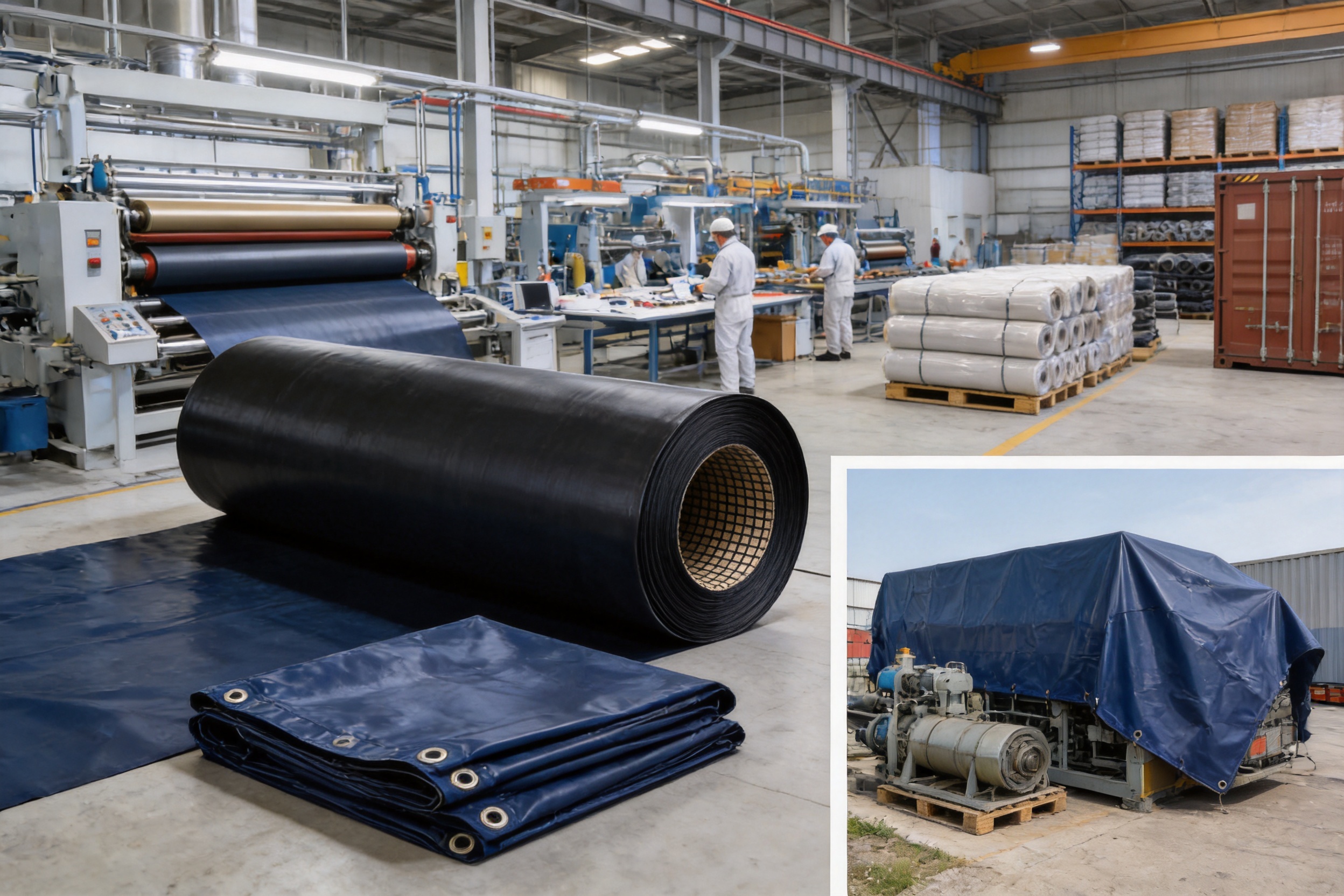
Industrial environments demand protective materials that can perform reliably under pressure. Construction sites, manufacturing plants, logistics yards, warehouses, agricultural facilities, transport operations, and temporary work areas all require coverings that can resist weather, abrasion, tearing, repeated handling, and accidental exposure to heat or flame. Ordinary tarpaulins may provide basic protection from rain and dust, but they are not always designed for demanding industrial conditions. A professional-grade fire-retardant tarpaulin offers a higher level of protection by combining reinforced construction, high tensile strength, controlled flame performance, and practical installation features.
The Fire-Retardant Professional-Grade Industrial Tarpaulin is engineered for users who need more than a temporary sheet. It is produced from a heavy-duty PVC-coated textile structure with a 500D × 500D base specification, a thread density of 18 × 12, and a total weight of 600 grams per square meter. These characteristics provide a balanced combination of strength, flexibility, handling convenience, and service durability. The material is suitable for applications where a cover must remain stable during repeated use while also supporting safety objectives in industrial areas.
Unlike lightweight consumer-grade covers, this industrial tarpaulin is intended to withstand demanding working conditions. Its reinforced edges help reduce stress around the perimeter, while regularly spaced metal grommets provide practical tie-down points. The material is also designed to resist tearing, puncturing, abrasion, and general wear. Available in various dimensions and colors, it can be adapted to different project requirements, from temporary enclosures to equipment covers and industrial partitions.
Fire-retardant performance is one of the product’s most important advantages. The material is tested according to DIN 75200, with a stated burning rate below 100 millimeters per minute, or below 3.9 inches per minute. This characteristic does not mean that the tarpaulin is fireproof or suitable for direct contact with open flame. Instead, it means that the material is formulated to limit flame spread under the specified test conditions. Correct product selection, installation, ventilation, and compliance with local fire regulations remain essential for every project.
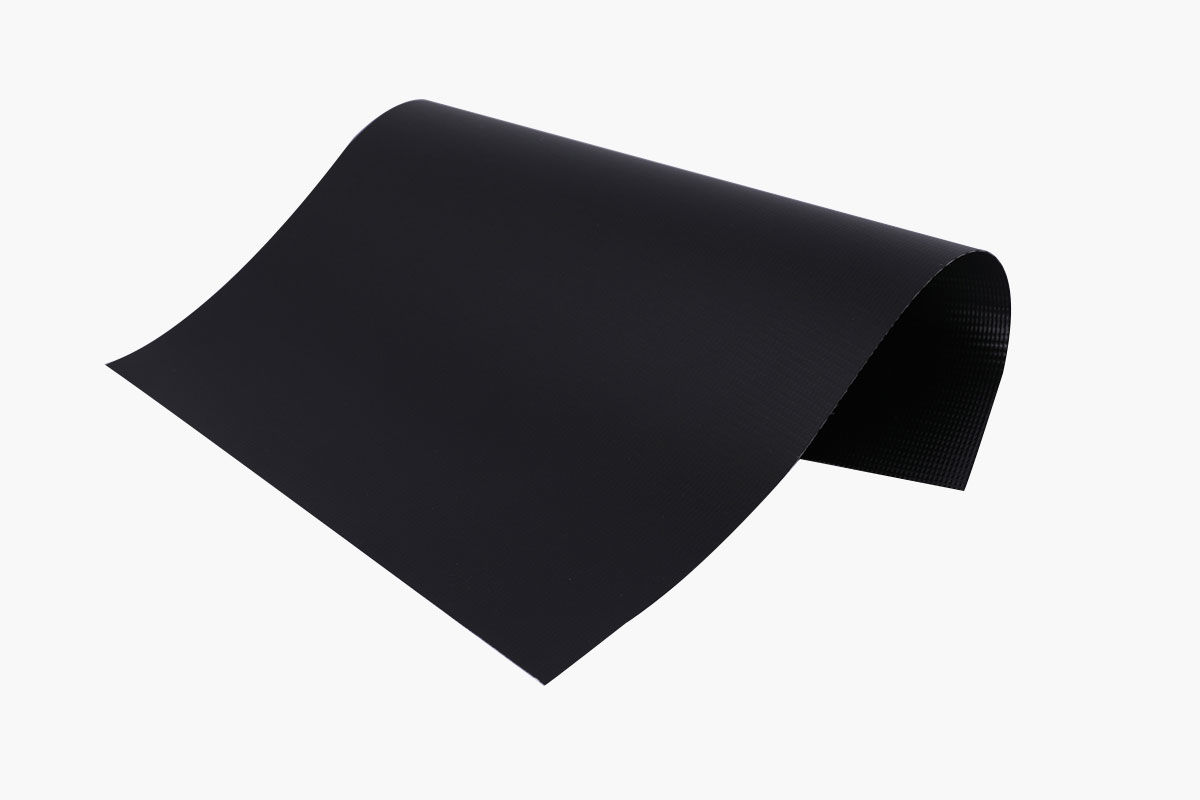
Fire-Retardant Professional-Grade Industrial Tarpaulin
A tarpaulin used in a professional environment is often exposed to conditions that are far more severe than those encountered in occasional household use. It may be pulled across rough surfaces, secured against strong wind, folded and unfolded repeatedly, exposed to machinery, or placed near welding and fabrication areas. A material that appears adequate at the time of purchase can fail prematurely if it lacks sufficient tensile strength, edge reinforcement, coating adhesion, or resistance to temperature variation.
Industrial tarpaulins serve several functions at once. They can protect machinery from rain, dust, oil splashes, and airborne debris. They can shield stored goods during transportation or outdoor storage. They can create temporary work zones, cover raw materials, separate production areas, and provide a protective barrier during construction. In each application, the covering must retain its physical integrity and remain securely positioned.
Failure can create direct and indirect costs. A torn cover may expose equipment to moisture. A detached sheet may damage nearby property or interrupt operations. Weak grommets can make secure installation difficult. Excessive flame spread can increase risk in a work area where heat-producing operations are present. For these reasons, professional buyers should evaluate a tarpaulin by its complete construction rather than by appearance or price alone.
The Fire-Retardant Professional-Grade Industrial Tarpaulin addresses these concerns through a combination of material weight, woven reinforcement, coating technology, perimeter strengthening, and standardized testing. Each element contributes to overall performance. The 600gsm construction provides substantial material density, while the 500D × 500D textile base supports dimensional stability. The edge binding and grommets make the product easier to install, and the flame-retardant formulation adds an important safety feature for suitable industrial applications.
The product uses a 500D × 500D specification, commonly associated with a durable woven reinforcement structure. The denier designation indicates the linear density of the yarn, and the balanced warp-and-weft configuration helps distribute loads in multiple directions. A balanced fabric construction is valuable because industrial tarpaulins are rarely loaded in only one direction. Wind, tension, folding, and handling can place stress across the length, width, and corners of the sheet.
The woven base functions as the internal strength layer. PVC coatings are then applied to provide resistance against water, dirt, abrasion, and environmental exposure. The strength of the finished material depends not only on the textile but also on the consistency of the coating, bonding, curing, and finishing processes. A properly manufactured coated fabric should maintain a stable surface without excessive cracking, delamination, or loss of flexibility during normal use.
A total weight of 600 grams per square meter gives this tarpaulin a robust industrial profile. Compared with lighter fabrics, a 600gsm material generally offers improved resistance to handling damage and puncture. It also provides a more substantial barrier against wind, dust, splash, and sunlight. The additional mass can help the cover remain stable when properly secured, although anchoring requirements will always depend on the size of the sheet, wind exposure, and installation method.
Material weight is not a complete measure of quality, but it is an important indicator when considered with tensile strength, tear strength, adhesion, and fabric construction. An excessively heavy material may be difficult to transport and install, while an overly light material may not withstand industrial handling. The 600gsm specification offers a practical middle ground for applications requiring professional durability without making the product unnecessarily difficult to use.
The perimeter of a tarpaulin experiences concentrated stress. Tie-down ropes, straps, hooks, and fastening systems typically pull against the edges and corners. Without reinforcement, the fabric may stretch, split, or develop small tears that gradually become larger. Reinforced edge binding distributes these forces over a wider area and helps protect the cut edges of the coated fabric.
Edge reinforcement also improves handling. Workers can fold, pull, and position the sheet with lower risk of immediate edge damage. This is particularly useful when the tarpaulin is installed over equipment, used as a temporary partition, or removed and stored between operations. Although reinforcement cannot compensate for incorrect installation or excessive loading, it provides a stronger foundation for repeated industrial use.
Metal grommets are installed at regular intervals along the edges to provide secure attachment points. They allow the user to connect ropes, bungee cords, straps, hooks, or other compatible fastening devices. Regular spacing makes it easier to distribute tension evenly rather than concentrating all force at one or two locations.
Evenly distributed tie-down points can improve stability during wind or movement. They also make the tarpaulin more adaptable to different frames and support structures. For best results, fasteners should be selected according to the expected load, and tension should be applied gradually across the perimeter. Pulling excessively on a single grommet can damage even a well-reinforced tarpaulin.
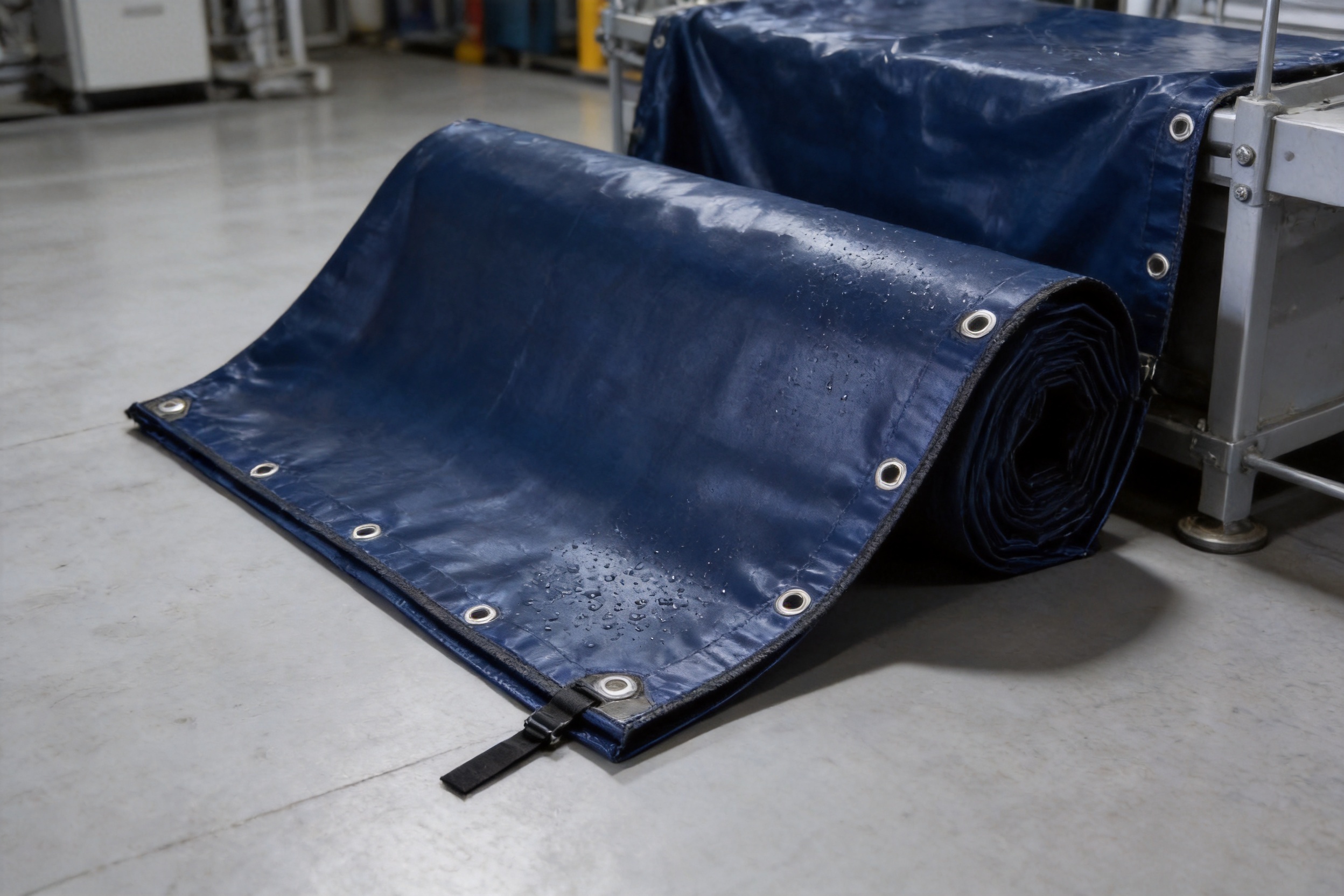
Fire safety is a central consideration wherever a flexible covering is used near heat, electrical equipment, welding, cutting, engines, or combustible materials. Traditional polyethylene or untreated textile sheets may ignite or allow flames to spread rapidly under certain conditions. A fire-retardant industrial tarpaulin is formulated to reduce the speed of flame travel when tested under a defined standard.
The supplied technical information identifies DIN 75200 as the fire protection test reference and states a burning rate below 100 millimeters per minute, or below 3.9 inches per minute. This information gives professional purchasers a useful basis for comparing material performance. However, test results should always be interpreted within their proper scope. A laboratory result is not a guarantee that the material will withstand every fire scenario, and the product should never be used as a substitute for certified fire barriers, fire curtains, protective clothing, or engineered fire suppression systems.
In practical terms, fire-retardant construction can help limit the rapid spread of flame across the tarpaulin surface. This may provide additional time for workers to respond, isolate equipment, or activate emergency procedures. The benefit is especially relevant in controlled industrial applications where the tarpaulin is used as a cover, temporary screen, enclosure, or partition and where ignition sources may be present.
Installation practices remain important. The material should be kept away from direct flame whenever possible. Welding, grinding, cutting, and other hot-work operations should be managed according to site safety procedures. Sparks can damage or penetrate coated fabrics even when the fabric has fire-retardant properties. Users should inspect the material after exposure to heat, sparks, chemicals, or mechanical impact and replace it if there is visible damage.
Fire-retardant performance may also be affected by contamination, aging, repairs, or modifications. Adhesives, paints, oils, dirt, and unapproved coatings can change surface behavior. If a project has formal regulatory requirements, purchasers should request current test documentation and confirm that the supplied material, thickness, color, and construction correspond to the documentation being reviewed.
The product specifications identify a tensile strength of 1,300/1,150 N per 5 centimeters. The two values generally represent strength in the principal fabric directions, although purchasers should confirm the exact testing orientation and reporting method with the supplier. High tensile strength is important because a tarpaulin may be pulled over a frame, subjected to wind uplift, or stretched during installation.
Tensile performance helps the sheet resist being pulled apart under longitudinal and transverse loads. It is particularly significant for large-format covers because forces can accumulate over a broad area. A material with adequate tensile strength is less likely to fail during normal tensioning, provided that the cover is not overloaded or installed with sharp folds and unsupported spans.
The listed tearing strength is 280/260 N. Tear resistance indicates how well the material can prevent a small cut, puncture, or nick from propagating. This is important in real working environments, where a cover may encounter a rough metal edge, a protruding fastener, a tool, or a sharp corner. Strong tear performance does not mean that damage can be ignored. Any cut should be assessed and repaired promptly because continued tension and wind movement can enlarge it.
The stated adhesion value is 70 N per 5 centimeters. Coating adhesion measures the bond between the coating layers and the textile support. Good adhesion helps prevent peeling, separation, and delamination during folding, tensioning, temperature changes, and repeated handling. It also contributes to long-term water resistance because an unstable coating may eventually create weak areas through which moisture can enter.
| Performance characteristic | Specified value | Practical significance |
|---|---|---|
| Base fabric | 500D × 500D | Balanced woven reinforcement for industrial use |
| Thread construction | 18 × 12 | Supports fabric stability and load distribution |
| Total weight | 600gsm | Substantial cover with durable handling characteristics |
| Tensile strength | 1,300/1,150 N per 5cm | Resistance to pulling forces in the primary directions |
| Tearing strength | 280/260 N | Helps limit propagation of cuts and punctures |
| Adhesion | 70 N per 5cm | Supports bonding between coating and textile layers |
| Temperature resistance | -15°C to +70°C | Suitable for a broad range of normal operating conditions |
| Maximum width | Up to 5 meters | Supports large-format fabrication and fewer seams |
| Fire performance reference | DIN 75200, below 100mm/min | Indicates controlled flame-spread performance under the stated test |
The stated temperature resistance range is -15°C to +70°C. This allows the tarpaulin to be used across many ordinary outdoor and indoor industrial conditions. It can support applications in cool storage yards, temperate construction environments, manufacturing spaces, transport areas, and warm outdoor locations.
Temperature resistance is important because coated fabrics expand and contract as conditions change. A material that becomes excessively brittle in cold weather may crack during folding or tensioning. A material that softens excessively in heat may stretch, deform, or lose dimensional stability. A defined temperature range helps users assess whether the product is suitable for a specific project.
Actual service life depends on more than air temperature. Direct solar radiation, wind, humidity, chemicals, pollution, mechanical movement, and storage conditions all influence material aging. If the tarpaulin is used in a hot climate with intense ultraviolet exposure, purchasers should ask about UV stabilization and expected outdoor service life. The company’s broader product capabilities include UV-resistant, cold-resistant, flame-retardant, antistatic, mildew-proof, and antibacterial material options, allowing buyers to discuss a construction that matches the intended environment.
Many conventional tarpaulins are designed primarily to block rain or dust. They may be sufficient for occasional household use, but they may not provide the mechanical strength or flame-control properties expected in a professional worksite. The featured product is designed as a complete industrial system, combining a reinforced textile base with a heavy PVC coating, strong edges, grommets, and fire-retardant performance.
This broader performance profile can reduce the need to use separate protective layers. A buyer may otherwise need one cover for weather, another screen for work-area separation, and additional measures to manage flame spread. While no single sheet can replace all safety equipment, a properly selected fire-retardant tarpaulin can provide multiple useful functions in one product.
Industrial covers are frequently moved, folded, secured, cleaned, and reused. Lightweight materials can become damaged at corners, grommet locations, and fold lines after repeated cycles. The 600gsm construction, reinforced edge binding, and strong textile base are intended to improve resistance to these common forms of wear.
Durability can offer economic benefits. A cover that remains serviceable for longer may reduce replacement frequency, installation labor, disposal costs, and unplanned downtime. Cost should still be evaluated on a total-use basis rather than by initial purchase price alone. The most economical product is often the one that delivers appropriate performance for the full application period.
The available width is up to 5 meters. Wide material can reduce the number of seams needed for large covers, which may simplify fabrication and improve appearance. Fewer seams can also reduce potential weak points and make cleaning easier. Large-format production is valuable for warehouse curtains, equipment covers, truck and trailer applications, temporary enclosures, and industrial partitions.
Project-specific dimensions should be confirmed before production. The final size may be affected by edge folds, hems, welding allowances, grommet placement, and installation tolerances. Buyers should provide accurate measurements and describe the intended fastening method so the product can be manufactured or finished appropriately.
The manufacturer is a China-based producer and exporter of flexible PVC films, digital printing fabrics, tarpaulin films, frontlit and backlit materials, double-sided printing fabrics, mesh, and related light-box cloth products. Its production experience covers several material categories that require controlled coating, calendering, bonding, finishing, and quality inspection.
The company was established in July 2010 and operates in Haining Dingqiao Industrial Park, Zhejiang Province. Its location provides access to major transportation routes and ports, including Shanghai and Ningbo, which supports export logistics and international order fulfillment. This geographic position can be useful for overseas buyers who require regular container shipments and coordinated delivery schedules.
Calendering is a key manufacturing process for many PVC-based flexible materials. In a calendering line, heated rollers process and form the PVC compound into a controlled film or coating layer. Precise control of temperature, roller pressure, speed, and material composition influences thickness, surface quality, flexibility, and consistency.
Advanced calendering equipment helps manufacturers produce material with more uniform coating characteristics across the width of the roll. Consistency is important for industrial tarpaulin because variations in thickness or bonding can create weak areas. Stable production parameters also support repeatability between batches, which is valuable for distributors, fabricators, and long-term project customers.
Multiple production lines provide additional manufacturing flexibility. They can support different widths, colors, weights, surface finishes, and product structures. They may also improve scheduling efficiency when the company is managing multiple orders or producing materials for different applications. A flexible production platform allows the supplier to address both standard products and customized requirements.
Bonding and welding facilities are important for coated-fabric manufacturing and finishing. They support the creation of reinforced edges, seams, hems, patches, and other structural details. Proper bonding requires control of heat, pressure, speed, and alignment. If these parameters are not managed correctly, seams may become weak, uneven, or vulnerable to peeling.
Professional bonding equipment can produce cleaner and more consistent finished details. This is especially important around high-stress areas such as corners, grommet zones, edge hems, and joined panels. The quality of these details can have a major effect on the service performance of a finished tarpaulin, even when the base fabric itself has excellent strength.
The company identifies ISO9001:2015 and GB/T19001-related certification information. Quality management systems help organize production procedures, documentation, inspection routines, corrective actions, and customer communication. Certification alone does not guarantee that every individual product is suitable for every application, but a structured quality system can improve process control and traceability.
For industrial buyers, useful quality checks may include visual inspection, weight measurement, width verification, tensile testing, tear testing, coating adhesion testing, grommet inspection, and flame-performance documentation. Customers should clarify which inspection reports are provided with an order and whether third-party testing is available for projects with formal compliance requirements.
With an annual output reported at approximately 45 million square meters, the manufacturer has substantial production capacity. More than 98 percent of its products are reported to be exported to Europe, America, the Middle East, Southeast Asia, and other regions. International export experience can support familiarity with packaging, container loading, commercial documentation, and communication with overseas customers.
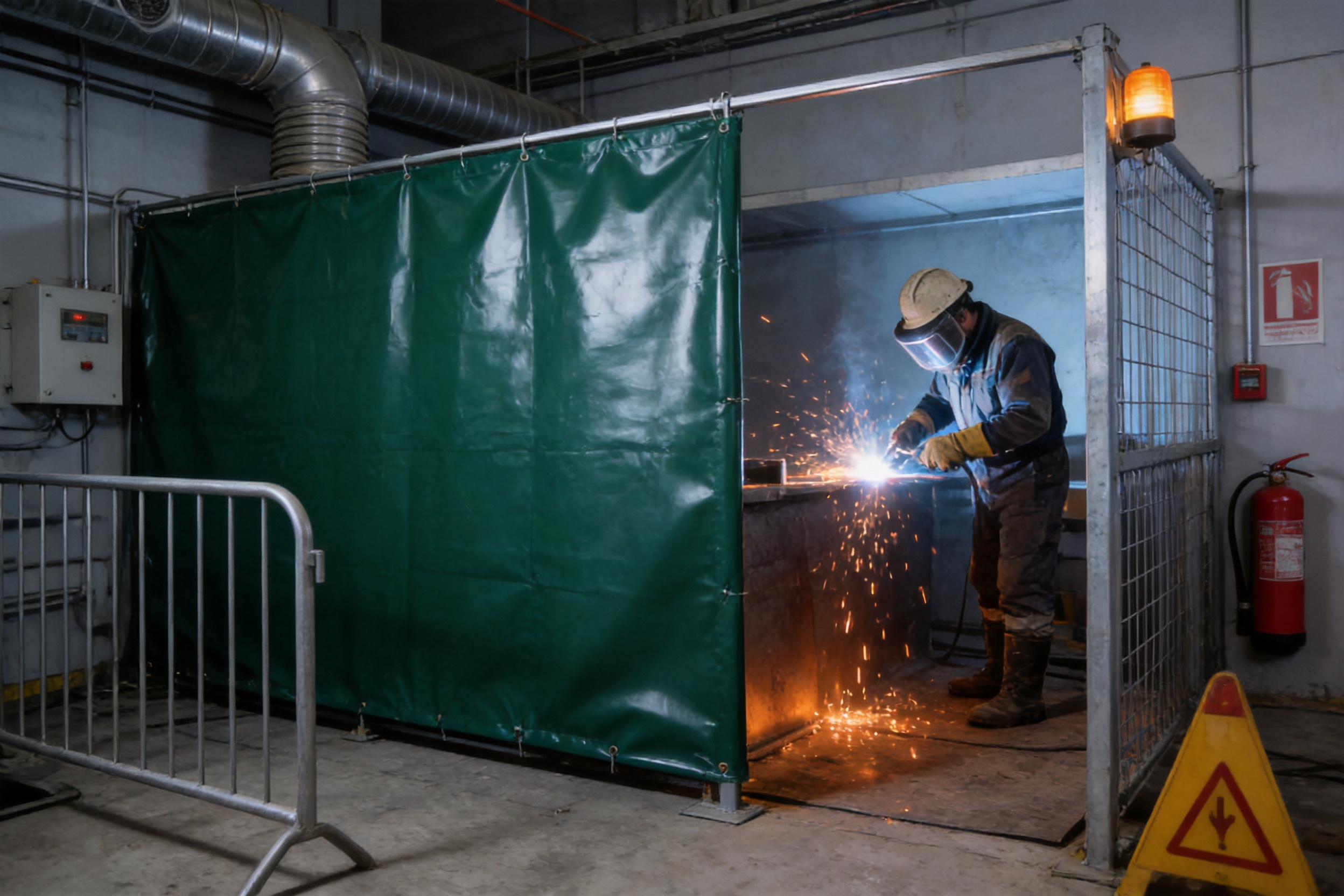
Construction sites require flexible barriers and covers that can tolerate dust, moisture, impact, and repeated movement. This tarpaulin can be used for equipment protection, temporary material storage, work-area separation, scaffolding covers, and weather shielding. Its fire-retardant performance may be valuable around selected construction operations, although hot-work procedures and certified fire protection systems remain mandatory where required.
The grommeted edges make it practical to secure the material to temporary frames, fences, railings, or support structures. The reinforced construction helps it tolerate routine repositioning as a project develops. Before installation, sharp edges should be covered, drainage should be considered, and wind loads should be evaluated.
Factories often need temporary or semi-permanent curtains to separate processes, protect machinery, or control dust and overspray. A heavy PVC-coated tarpaulin can provide a robust physical barrier while remaining removable when production layouts change. The fire-retardant formulation is relevant in selected areas where heat-producing equipment or sparks may be present.
Manufacturing users should identify exposure to oils, solvents, acids, alkalis, cleaning chemicals, and hot particles before ordering. Chemical compatibility varies by substance and concentration. If the material will be exposed to aggressive chemicals, a sample evaluation or written compatibility recommendation should be obtained.
Transport operations use covers to protect cargo from rain, dust, sunlight, and road debris. The fabric’s strength and grommet system can support truck, trailer, container, and yard applications when properly fabricated and tensioned. Large widths may help create broad panels with fewer joins.
For vehicle use, the cover must be designed for movement, vibration, airflow, and legally required securing methods. It should not obstruct lights, license plates, safety equipment, or driver visibility. The buyer should specify whether the tarpaulin will be used for stationary storage or active road transport because the design and fastening requirements may differ substantially.
Warehouses and outdoor storage yards can use industrial tarpaulins to protect pallets, machinery, raw materials, and packaged goods. The material can provide a physical layer against rain, dust, and incidental contact. When used outdoors, the sheet should be installed so that water drains away rather than collecting in low areas.
Proper ventilation is important when covering goods that may release heat or moisture. A completely sealed cover can trap condensation, which may damage metal, packaging, or stored products. Users should balance weather protection with airflow and should inspect the covered goods regularly.
The material may also be suitable for selected agricultural covers, equipment protection, temporary shelters, and utility applications. Its durability can be useful where covers are moved regularly or exposed to outdoor handling. However, agricultural users should consider contact with fertilizers, pesticides, animal waste, oils, and prolonged ultraviolet exposure before selecting the product.
Industrial projects rarely have identical requirements. The product is available in a variety of sizes and colors, allowing buyers to coordinate covers with site layouts, equipment categories, safety systems, or company identification. Color can also support operational organization, such as using different colors for different work zones or material types.
Customization may include finished dimensions, edge construction, grommet spacing, corner reinforcement, welding, hems, surface treatments, and packaging. Buyers should provide a technical specification rather than relying only on a general product name. The specification should identify the required length, width, finished tolerance, color, edge treatment, grommet material, grommet interval, and intended application.
The listed minimum order quantity is one 20-foot container. The stated delivery time is approximately 20 working days, subject to order confirmation, production scheduling, customization, material availability, and shipping arrangements. Payment terms include a deposit and balance through T/T or L/C, with delivery options such as FOB, CIF, and CNF available for discussion.
Because international orders involve logistics variables, buyers should confirm the exact commercial terms before placing an order. They should also review packaging requirements, roll or folded dimensions, container loading plans, customs documentation, inspection procedures, and responsibility for transport insurance.
Correct installation is essential for achieving the expected life of an industrial tarpaulin. Before use, inspect the sheet for cuts, punctures, coating defects, damaged grommets, and contamination. Confirm that the supporting frame has no sharp projections that could abrade the material. If necessary, install protective pads or rounded edge guards at contact points.
Use all appropriate grommet locations when wind or movement is expected. Fasteners should be strong enough for the application but should not cut into the grommet or fabric. Tension should be distributed evenly. Excessive tension can damage the edge, while insufficient tension may allow the material to flap and suffer fatigue damage.
Avoid creating pockets where rainwater can collect. Standing water adds significant weight and can overstress the fabric, grommets, and supporting structure. For temporary shelters, provide suitable slope and drainage. For equipment covers, allow sufficient clearance so that water does not remain trapped against sensitive surfaces.
Do not drag the tarpaulin across abrasive concrete, gravel, metal edges, or contaminated ground. Lift and reposition it whenever possible. When folding, avoid forcing sharp creases in extremely cold conditions. Store the material clean and dry, away from direct sunlight, heat sources, chemicals, rodents, and objects that could puncture it.
Routine maintenance can extend the useful life of the product. Light dirt can generally be removed with water and a soft brush or cloth. Strong solvents, abrasive cleaners, and unapproved chemicals should be avoided because they may damage the coating or affect fire-retardant performance. Any cleaning method should first be tested on a small, inconspicuous area.
After cleaning, allow the tarpaulin to dry fully before folding and storage. Moisture trapped between folded layers can encourage mildew or create unpleasant odors. If mildew appears, use a cleaning procedure recommended for coated PVC fabrics and avoid aggressive scrubbing that could damage the surface.
Inspect the tarpaulin at regular intervals, especially after storms, relocation, hot-work exposure, or heavy use. Check the corners, hems, grommets, seams, folds, and areas that contact support structures. Small defects are easier to repair than large failures. Repairs should use compatible materials and methods, particularly when maintaining water resistance or fire-related performance is important.
Service life depends on application and environment. A cover used indoors with limited movement may remain functional for a long period, while one exposed to constant wind, sharp contact, intense sunlight, and chemical contamination may require more frequent replacement. Users should establish an inspection schedule based on actual operating conditions rather than assuming a fixed lifespan.
Lower-grade covers may have a lower purchase price, but they can differ significantly in fabric density, edge construction, grommet quality, coating adhesion, and flame behavior. Some lightweight products are appropriate for occasional, low-risk tasks. They may not be appropriate for heavy industrial use, repeated installation, or areas where flame-spread control is an important consideration.
The featured tarpaulin provides several performance advantages in one specification. Its 600gsm weight gives it a substantial structure. The 500D × 500D reinforcement supports load resistance. The tensile and tear values provide measurable mechanical benchmarks. The reinforced edge and metal grommet system support practical installation. The fire-retardant treatment addresses a safety concern that is not covered by ordinary waterproofing alone.
Professional buyers should avoid making a decision based solely on nominal weight or a general statement such as “heavy duty.” A fair comparison should examine the full technical data sheet, test methods, tolerances, coating adhesion, fabric construction, temperature range, available widths, edge finishing, and documentation. The product that appears cheaper initially may become more expensive if it requires frequent replacement or causes operational disruption.
Fire-retardant does not mean noncombustible. The term describes a material property under specified test conditions. It should not be interpreted as permission to place the tarpaulin directly over open flames, hot exhausts, furnaces, welding arcs, or other uncontrolled ignition sources. A fire-retardant sheet can still melt, burn, shrink, release smoke, or lose strength when exposed to sufficient heat.
Site managers should conduct a risk assessment before using any flexible cover. Consider ignition sources, combustible storage, escape routes, ventilation, emergency access, fire detection, sprinkler coverage, and local regulations. Where a certified fire-rated assembly is required, the tarpaulin should be evaluated as part of that assembly or replaced with an approved specialized product.
Employees should receive clear instructions on installation, inspection, cleaning, repair, and response to heat or flame exposure. Damaged material should be removed from service if its structure or surface has been compromised. These practices help ensure that the product contributes to workplace safety without being used beyond its design purpose.
The manufacturer’s product range extends beyond industrial tarpaulins. Its portfolio includes PVC films, digital printing fabrics, frontlit and backlit media, double-sided printing fabrics, mesh, and other flexible materials. This breadth indicates experience with several coated-fabric technologies and can be useful for buyers seeking coordinated products for printing, signage, enclosure, transport, and industrial applications.
The company reports a production capacity of approximately 45 million square meters annually and exports the majority of its output. For international customers, export experience can support order coordination, container planning, commercial documentation, and communication regarding specifications. The company’s location in Zhejiang Province also provides access to established manufacturing and port infrastructure.
Technical communication is particularly important for custom industrial products. A capable supplier should be able to discuss fabric construction, coating weight, flame testing, color, finished size, edge details, grommet placement, packaging, and inspection requirements. Buyers should provide drawings or photographs where the application is unusual and should request samples when performance or appearance is critical.
Before ordering, confirm the exact product model and technical construction. The listed item number is TWP-0505-600, with a 500D × 500D fabric, 18 × 12 thread construction, and 600gsm total weight. Confirm whether these values apply to the full finished product or to a particular production series.
Request the applicable fire-performance test information and verify the test method, sample construction, date, and laboratory details. If the product will be used in a regulated facility, compare the documentation with local building, fire, transport, and occupational safety requirements.
Confirm finished dimensions and tolerances. For large panels, ask about maximum roll width, seams, hems, folding direction, and packaging. Review grommet type, material, spacing, reinforcement, and corner construction. These details can be more important than color when the tarpaulin will experience wind or repeated movement.
Discuss chemical exposure, ultraviolet exposure, temperature, cleaning, and storage conditions. If the tarpaulin will be used near oils, solvents, acids, alkalis, fertilizers, or hot particles, provide the supplier with detailed information. A sample trial may be appropriate before a large purchase.
Finally, clarify minimum order quantity, delivery schedule, payment terms, shipping basis, inspection arrangements, and after-sales communication. A clear written specification reduces misunderstandings and helps both buyer and manufacturer evaluate whether the product is suitable for the intended application.
It is designed to provide a durable protective cover for industrial, construction, manufacturing, transport, storage, and related applications. It combines weather protection, mechanical strength, reinforced fastening points, and fire-retardant performance under the stated test conditions.
No. It is fire-retardant rather than fireproof. The material is reported to meet a burning-rate requirement referenced to DIN 75200, but it can still be damaged or ignited by sufficient heat or direct flame. It should not replace certified fire barriers or established hot-work safety procedures.
600gsm means that the material has a nominal weight of 600 grams per square meter. This relatively substantial construction supports durability and resistance to handling damage, although total performance also depends on the textile reinforcement, coating, bonding, edge construction, and installation.
It describes the denier specification of the reinforcing yarns in the primary fabric directions. A balanced 500D × 500D structure supports resistance to pulling forces across the length and width of the tarpaulin.
Yes, it can be used for many outdoor applications, subject to correct installation and environmental evaluation. The stated temperature range is -15°C to +70°C. Long-term ultraviolet exposure, wind, chemicals, moisture, and temperature cycles should be considered when estimating service life.
The product is available in various sizes, with a stated maximum width of up to 5 meters. Exact finished dimensions, seams, hems, and grommet spacing should be confirmed for each order.
Edges receive concentrated force from ropes, straps, hooks, and wind. Reinforced edge binding distributes that force, protects the cut edge, and helps reduce tearing around fastening points.
Use water and a soft brush or cloth for ordinary dirt, then allow the material to dry fully before folding. Avoid aggressive solvents and abrasive cleaners unless the supplier confirms compatibility. Test any cleaning method on a small area first.
Potential customization may include size, color, edge treatment, grommet spacing, corner reinforcement, seams, and packaging. Buyers should provide a complete technical specification and confirm available options before production.
The listed minimum order quantity is one 20-foot container. Buyers should confirm the current minimum quantity, loading capacity, and delivery schedule when requesting a quotation.
The listed delivery time is approximately 20 working days. Actual timing may vary according to order details, customization, production scheduling, inspection, holidays, and shipping arrangements.
The listed payment methods include T/T and L/C, with an earnest payment and balance arrangement. Delivery terms such as FOB, CIF, and CNF can be discussed with the supplier.
Users should review the site’s hot-work procedure, maintain safe separation from sparks and flame, protect the tarpaulin from hot particles, and inspect it after use. Fire-retardant performance does not eliminate the need for fire watches, protective screens, ventilation, and other required controls.
The Fire-Retardant Professional-Grade Industrial Tarpaulin is designed for users who require a dependable, heavy-duty cover rather than a basic disposable sheet. Its 600gsm construction, 500D × 500D reinforcement, 18 × 12 thread specification, tensile strength, tear resistance, coating adhesion, reinforced edges, and regular metal grommets provide a well-rounded industrial performance profile.
Its flame-retardant treatment, tested according to the stated DIN 75200 reference, adds an important layer of protection for appropriate industrial applications. The material remains subject to the limits of flexible coated fabric and must be installed, inspected, and used in accordance with site safety requirements.
The manufacturer strengthens the product offering through broad PVC and flexible-material expertise, calendering equipment, multiple production lines, professional bonding facilities, quality-management practices, export experience, and large production capacity. These capabilities support standard and customized orders for customers across construction, manufacturing, logistics, warehousing, agriculture, and other sectors.
For buyers, the most effective approach is to evaluate the complete application: expected loads, temperature, flame exposure, weather, chemicals, dimensions, fastening method, cleaning, storage, and compliance requirements. When the specification matches the environment, this industrial tarpaulin can provide a practical combination of durability, safety-oriented performance, installation convenience, and long-term value.
1. DIN 75200, Determination of the Flammability of Materials Used in the Interior of Motor Vehicles.
2. GB/T 3923.1-2013, Textiles—Tensile Properties of Fabrics—Determination of Maximum Force and Elongation at Maximum Force Using the Strip Method.
3. ISO 9001:2015, Quality Management Systems—Requirements.
4. Technical product information for Fire-Retardant Professional-Grade Industrial Tarpaulin, item TWP-0505-600.
5. Manufacturer-provided specifications for coated fabrics, PVC films, tarpaulin materials, and related flexible textile products.
6. General industrial guidance concerning the selection, installation, inspection, cleaning, and storage of coated-fabric tarpaulins.
Fire-Retardant Professional-Grade Industrial Tarpaulin
 Industrial-Grade Reinforced UV-Resistant Clear Tarpaulin
 Heavy-Duty High-Performance Camouflage-Printed Tarpaulin
 Heavy-Duty Reinforced Waterproof Tarpaulin
 Fluorescent Reflective Tarpaulin For Car Emergency Warning Triangle
 Weatherproof Printable Waterproof Tarpaulin For Camper RV
 Custom Digital Printing Fabric Manufacturers

 Previous