

 English
 中文简体
 Español
News
Home / Author / Shen Yaqin — International Sales Manager / Decorative Waterproof Tarpaulin for Garden Fence Screening: A Practical Guide to Privacy, Protection, and Outdoor Design


Content
Garden fence screening has developed from a simple privacy accessory into an important outdoor improvement product. Homeowners, property managers, retailers, landscapers, and contractors increasingly expect a fence covering to do more than hide an open boundary. The ideal material should create privacy, improve the appearance of a garden, resist rain and moisture, tolerate outdoor exposure, remain easy to install, and offer dependable performance over time.
Decorative waterproof tarpaulin for garden fence screening is designed to meet these combined requirements. It provides a dense visual barrier for open railings and grid fences while also functioning as a weather-resistant outdoor covering. Its printable surface allows natural landscape patterns, including stone, hedge, wood-grain, and other decorative designs, to be applied according to market preferences. As a result, the material can turn a plain metal fence into a visually coordinated garden feature.
Unlike lightweight fabric screens that may absorb water or quickly lose their appearance, this type of tarpaulin combines a 300D × 500D base construction, an 18 × 12 weave specification, and an approximate weight of 450 grams per square meter. Its waterproof coating, anti-UV treatment, and dense structure are intended to provide improved performance in rainy and changeable outdoor climates, including many regions of Europe.
The material is also suitable for commercial distribution. Narrow, consumer-friendly rolls, including formats such as 0.19 meters by 35 meters or 0.19 meters by 50 meters, can be produced for weaving through conventional European grid fences. Custom cutting, carton packaging, and individual retail preparation support home improvement stores, garden centers, DIY chains, online sellers, and professional installers.
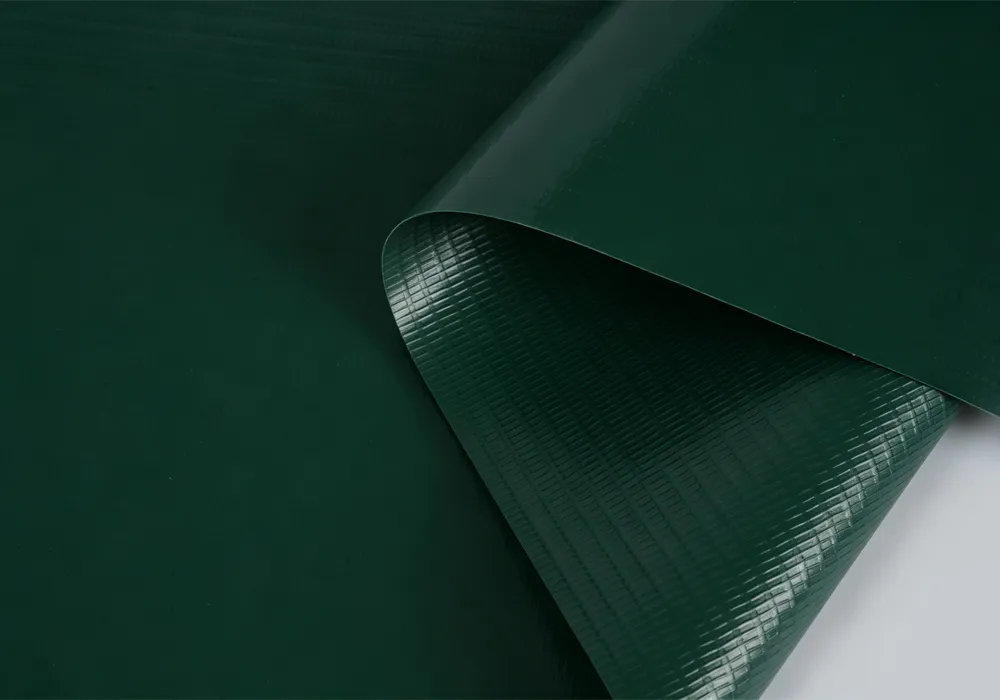
Decorative Waterproof Tarpaulin For Garden Fence Screening
Decorative waterproof tarpaulin is a coated textile material developed for outdoor covering and screening applications. In a garden fence installation, the product is normally placed along the inside or outside of a metal railing, wire panel, mesh fence, balcony barrier, or similar open structure. The tarpaulin blocks direct views through the fence and creates a more enclosed outdoor environment.
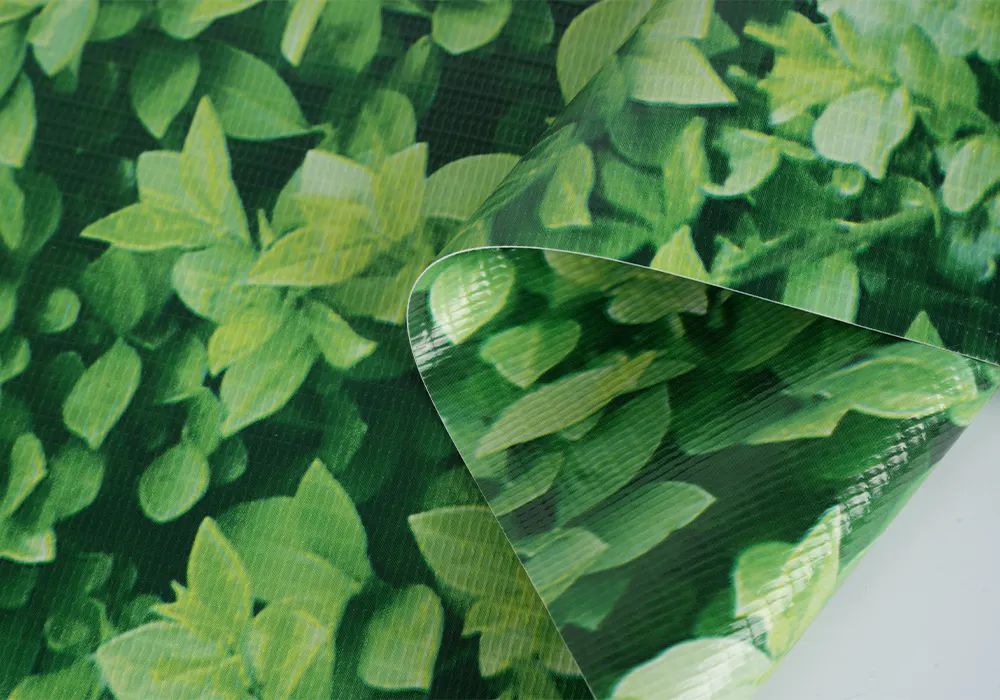
The material is not limited to plain, industrial-looking applications. Its printable outer surface can carry decorative imagery and repeated patterns. A hedge design can create the impression of a green boundary, while a wood-grain design can complement timber garden furniture. Stone and brick effects may suit courtyards, terraces, commercial properties, and renovation projects where a permanent wall is impractical or too expensive.
The product is especially useful where the customer wants an immediate visual improvement without building a solid fence. A traditional wall requires foundations, construction labor, permits in some locations, and considerable expense. A screening tarpaulin can often be cut, positioned, and secured to an existing fence with relatively simple installation work.
Its main functions can be summarized as follows:
• Privacy screening: The dense construction is intended to block direct lines of sight through the fence.
• Decorative enhancement: Digital printing allows the surface to carry landscape or architectural patterns.
• Rain protection: The coated structure helps prevent rainwater from passing through the material.
• Moisture resistance: The waterproof surface reduces water absorption and helps discourage outdoor mildew development.
• UV resistance: Anti-UV treatment helps slow fading caused by prolonged sunlight exposure.
• Adaptable installation: The flexible sheet can be cut and fitted to different fence lengths and configurations.
• Retail suitability: Narrow rolls and customized packaging make the product convenient for consumer distribution.
Material selection is central to the performance of any outdoor screen. Garden fence coverings are exposed to rain, sunlight, wind movement, dust, temperature variation, and repeated handling during installation. A product that is too light may tear easily, while a product that is excessively rigid may be difficult to weave through a fence or secure around corners.
The specified construction uses 300D × 500D yarns, an 18 × 12 weave, and an approximate basis weight of 450 grams per square meter. These specifications indicate a substantial coated fabric suitable for demanding outdoor applications. The different yarn sizes can contribute to a balanced structure, combining flexibility with resistance to pulling and handling stress.
| Property | Specified Value | Practical Significance |
| Base construction | 300D × 500D | Supports a durable and flexible coated textile structure |
| Weave specification | 18 × 12 | Provides a dense base for screening and coating adhesion |
| Approximate weight | 450 g/m² | Offers substantial coverage and improved handling strength |
| Tensile strength, warp | 200 N/5 cm | Helps the material resist pulling during installation and use |
| Tensile strength, weft | 180 N/5 cm | Supports stability across the width of the screen |
| Tearing strength, warp | 100 N | Helps limit propagation of accidental tears |
| Tearing strength, weft | 80 N | Provides resistance to tearing from handling or localized stress |
| Adhesion | 60 N/5 cm | Supports bonding between coating layers and the textile base |
These values provide a useful technical reference for buyers and distributors. Actual performance can depend on installation method, edge treatment, fastener spacing, wind exposure, printing process, storage conditions, and environmental factors. Nevertheless, the specification demonstrates that the product is designed as a functional outdoor material rather than as a temporary decorative cloth.
The approximate 450 g/m² weight also provides a useful balance. A lighter textile could be easier to transport, but it may offer less opacity and lower resistance to mechanical stress. A substantially heavier sheet may be more difficult to handle and may place greater loads on fence posts and fastening points. The stated construction is intended to provide a practical compromise for garden and fence-screening applications.
Privacy is usually the first reason a customer purchases a fence screen. Open metal fences can expose patios, gardens, swimming areas, balconies, play spaces, and outdoor seating to passersby. Decorative waterproof tarpaulin creates a continuous surface across the open sections of the fence, reducing direct visibility and making the space feel more private.
The dense material is designed for opaque sight blockage. In practical use, the degree of privacy will depend on correct installation, overlap at joints, the height of the fence, the viewing angle, and whether gaps remain at the top, bottom, or sides. For best results, the screen should be measured carefully and attached without leaving unnecessary openings.
Compared with loosely woven shade cloth, the tarpaulin offers a more solid visual barrier. Shade cloth may reduce visibility while still allowing outlines, movement, or light to pass through. A dense coated tarpaulin is better suited to customers who want a stronger separation between the garden and the surrounding area.
The privacy effect can be particularly valuable in residential environments. A small urban garden may be located close to a sidewalk or neighboring property. A terrace may face a busy road. A ground-floor apartment may need a discreet outdoor boundary. In each of these situations, the screen can create a more comfortable environment without requiring permanent masonry construction.
Privacy screening can also support commercial and public uses. Restaurants may use printed fence coverings to separate outdoor dining spaces from service areas. Construction sites may cover temporary fencing to reduce visual clutter. Holiday parks, sports facilities, and event organizers may use printed screens to divide activity zones or provide a more finished appearance.
A major advantage over plain industrial tarpaulin is the ability to use decorative printing. The outer surface can be customized with repeated patterns or realistic visual themes that coordinate with the surrounding landscape. This gives retailers and project designers more options than a basic green or gray screen.
Hedge and foliage patterns are suitable for customers who want a garden-oriented appearance. They can create a visual continuation of natural greenery even where the actual fence borders a paved area. Wood-grain patterns can complement timber decking, garden furniture, pergolas, and rustic landscaping. Stone effects can provide a decorative courtyard style without the weight and cost of real stone.
Printing also creates opportunities for commercial branding and tailored projects. Although the principal application is garden screening, the same type of coated material may be adapted for property development, temporary partitions, event fencing, promotional barriers, and exterior visual displays. Retailers can offer standard designs for fast-moving consumer demand while also accepting special orders for customized graphics.
Color consistency and print quality are important in outdoor applications. The manufacturing process must provide a smooth, receptive surface and stable coating characteristics. A properly prepared substrate helps support clear printed details, even color areas, and an attractive finished appearance. Anti-UV treatment is also important because outdoor graphics are exposed to sunlight for extended periods.
Customers should understand that all outdoor printed materials may experience some gradual color change under severe sunlight, especially in high-temperature or high-UV environments. Anti-UV treatment does not make a printed screen completely immune to weathering. Instead, it helps slow the fading process and improves the expected visual life compared with an untreated material.
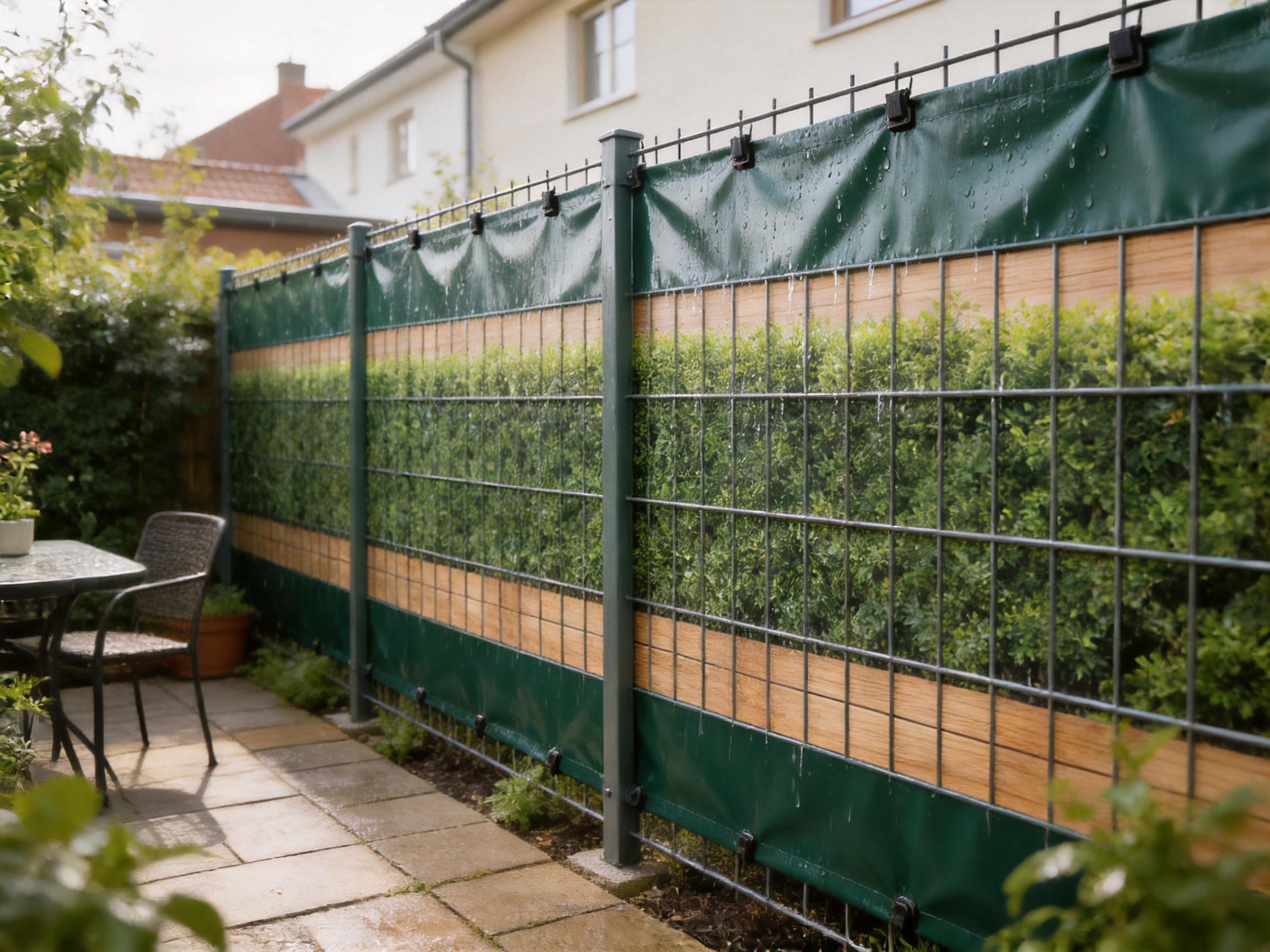
Garden fence screens are frequently installed in places where rain, humidity, and condensation are unavoidable. If a fabric absorbs water, it may become heavy, remain damp for long periods, develop an unpleasant odor, or provide conditions favorable to mildew. A waterproof coated tarpaulin is intended to reduce these risks.
The dense coating forms a barrier that limits water penetration through the sheet. Rainwater should run across the surface rather than soak into the textile base. This helps the material dry more quickly after rainfall and reduces the chance of prolonged moisture retention. The feature is especially relevant in northern and central European regions, where outdoor products may face repeated rain and damp conditions throughout the year.
Water resistance also helps protect the appearance of printed designs. When moisture enters a textile structure, it can contribute to staining, surface contamination, and biological growth. A coated surface is easier to wipe and maintain than an untreated woven fabric. Normal care may involve removing leaves, dirt, and standing deposits with a soft brush or low-pressure water cleaning method appropriate for the finished product.
The waterproof layer should not be confused with a guarantee that every installation will remain completely dry under all conditions. Water may still enter through cut edges, stitching holes, seams, fastening points, or gaps between sections. Installation quality therefore remains important. If the product is cut on site, installers should avoid unnecessary damage and use suitable edge reinforcement or fastening methods where required.
For a fence screen, waterproofing has another practical benefit: it helps preserve the dimensional stability of the covering. Excessive water absorption can make some fabrics stretch, sag, or become difficult to handle. A coated tarpaulin is better positioned to maintain a consistent appearance when properly tensioned and attached.
Mildew and moss are common concerns in damp gardens, shaded courtyards, and rainy climates. Biological growth can make a fence covering appear old and neglected, even when the underlying fence is in good condition. A waterproof, dense coating reduces the opportunity for water and contaminants to remain within the material.
The product is described as resistant to mildew development in open-air applications. This is supported by the waterproof coating and the reduced moisture absorption of the finished structure. However, resistance is influenced by cleanliness, airflow, local humidity, installation orientation, and the accumulation of organic debris. A screen that is constantly covered by leaves or pressed against a wet wall may require more frequent maintenance than a freely exposed screen.
Routine maintenance is straightforward. Loose dirt can be removed with a soft brush. Surface deposits can generally be treated with clean water and a mild cleaning solution compatible with coated PVC materials. Harsh solvents, abrasive pads, and aggressive pressure washing should be avoided unless specifically approved for the product, because they may damage the coating or printed surface.
For retailers, the anti-mildew benefit is a strong selling point in areas where customers regularly experience wet weather. It addresses a familiar problem with many low-cost fabric screens and positions the tarpaulin as a more durable, lower-maintenance alternative.
Sunlight is one of the most important long-term stresses affecting outdoor materials. Ultraviolet radiation can cause color fading, surface embrittlement, cracking, and loss of flexibility. The product incorporates anti-UV treatment to help slow these effects.
UV resistance is valuable for both the base fabric and the printed design. A plain screen may remain mechanically usable while its color becomes unattractive. A decorative product must preserve its visual quality because appearance is part of its primary function. Anti-UV additives and suitable coating technology help maintain the surface for a longer period under normal outdoor exposure.
Weather durability also depends on temperature. Garden screens may experience summer heat, winter cold, frost, and repeated expansion and contraction. The product is designed as a flexible coated material rather than a rigid panel, allowing it to accommodate ordinary movement caused by temperature and mild pulling.
It is important to distinguish mild pulling from excessive wind loading. Any continuous screen increases the surface area presented to wind. A secure fence structure, suitable fastener spacing, reinforced edges, and allowance for local wind conditions are essential. In exposed locations, installers should evaluate whether the fence posts and supporting structure can withstand the additional load.
Compared with fragile decorative fabrics, the specified tensile and tearing properties provide greater confidence during installation. The material can be cut and positioned while maintaining a substantial level of mechanical strength. Correct handling remains necessary, but the product is designed to withstand normal fitting operations more effectively than thin, low-weight alternatives.
One of the practical strengths of tarpaulin screening is its flexibility. The material can follow the line of a fence, pass through the openings of a grid panel, and be adapted around corners and posts. It can also be cut to suit shorter runs, gates, balconies, and irregular sections.
Before installation, the customer should measure the total fence length and height. Additional material may be required for overlaps, end returns, and attachment around posts. If the screen is woven through a grid fence, the installer should decide whether the strip will pass through every opening or alternate openings. The selected pattern affects privacy, appearance, material consumption, and wind exposure.
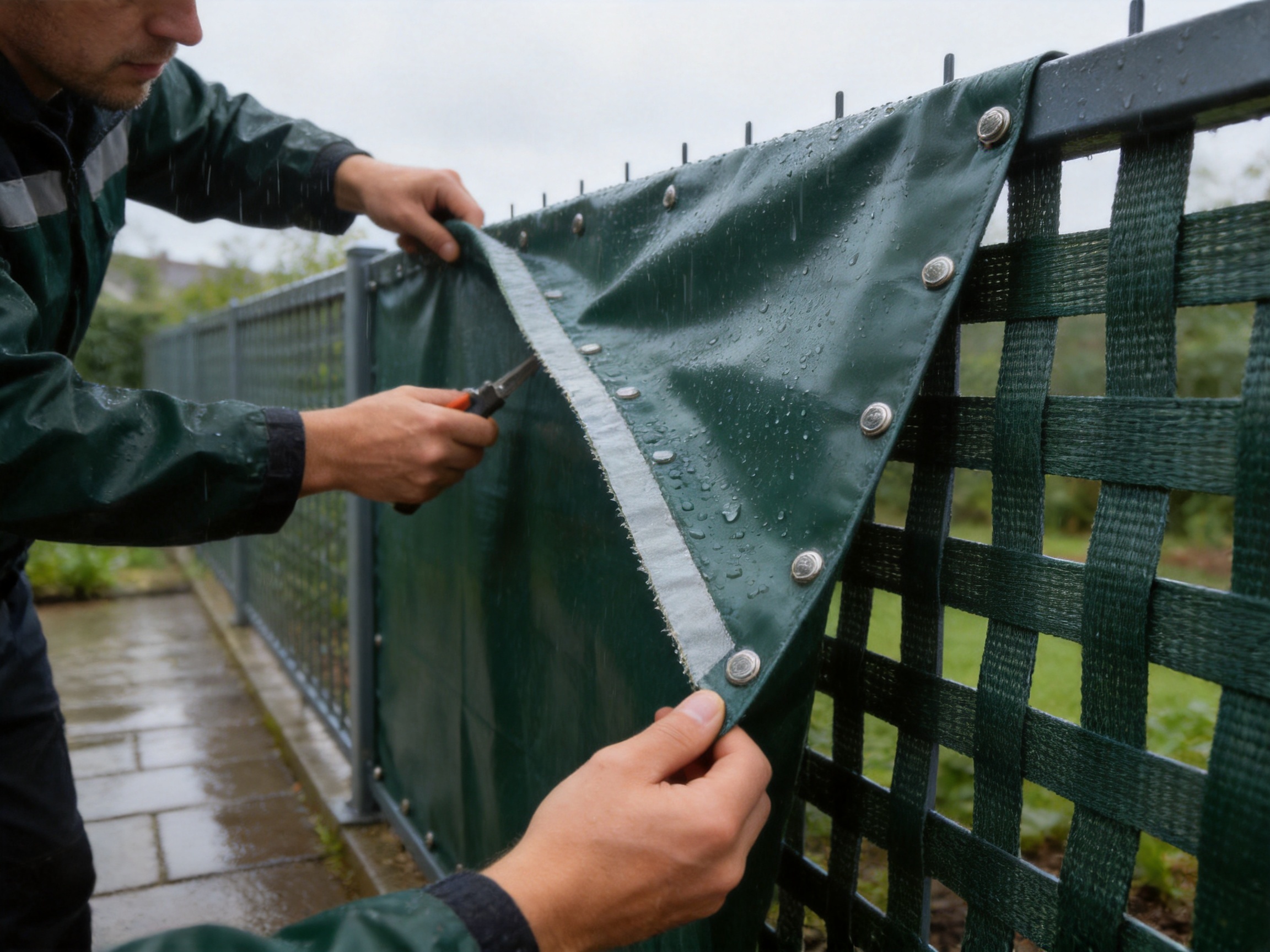
Common attachment methods may include cable ties, lacing cord, clips, eyelets, rope, or other suitable fasteners. Fasteners should be spaced closely enough to prevent excessive flapping but not so tightly that they cut into the material. Rounded or reinforced attachment points are preferable where available.
For long runs, installation should begin with the screen aligned and lightly tensioned. Excessive pulling can distort the material or overload fence posts. The screen should remain smooth without being stretched beyond its intended condition. At corners, gradual folding is generally preferable to sharp creasing.
Cutting is another advantage. Large rolls can be converted into project-specific lengths by retailers, contractors, or end users. Clean cutting equipment helps maintain a neat edge. Where repeated handling or wind stress is expected, edge reinforcement, welded hems, or additional fastening points may be specified during production.
The product’s flexibility also benefits retail packaging. Narrow rolls are easier for consumers to carry, store, and transport than large rigid panels. A roll measuring 0.19 meters by 35 meters or 0.19 meters by 50 meters can be positioned as a convenient DIY product for standard European fence systems.
Customers can choose from many types of garden screening, including natural reed, bamboo, knitted shade cloth, polyester fabric, PVC mesh, wooden panels, artificial hedge rolls, and solid plastic sheets. Each material has a place in the market, but decorative waterproof tarpaulin offers a distinct combination of functions.
Natural reed and bamboo provide an attractive organic appearance, but they may become brittle, split, or discolor after long exposure to rain and sunlight. Their natural irregularity can also create gaps that reduce privacy. Decorative tarpaulin offers more consistent coverage, printed design options, and improved resistance to water penetration.
Shade cloth is often breathable and relatively inexpensive, but it may not provide the same level of opaque coverage. Some knitted screens can stretch, fray, or retain moisture. A dense coated tarpaulin is better suited to customers who prioritize strong visual blockage and a more substantial waterproof barrier.
Rigid panels can provide privacy, but they are usually more difficult to transport and install. They may require stronger posts and specialized connectors. Tarpaulin is lighter, rollable, and easier to adapt to different fence shapes. It can also be removed or replaced without major structural work.
Plain tarpaulin may offer weather protection but can look utilitarian in a residential garden. The printable surface of decorative screening adds an aesthetic dimension. Retailers can offer landscape designs that are more appealing to homeowners and more suitable for finished outdoor spaces.
Artificial greenery can produce a natural visual effect, but it may be bulky, difficult to clean, and expensive over long fence runs. Printed tarpaulin can reproduce the impression of greenery with a flat, space-efficient form. It is easier to roll, package, and customize.
The most common application is residential garden fencing. Homeowners can screen patios, front gardens, rear boundaries, balconies, and poolside areas. The product can be used to improve privacy without replacing an existing fence.
In urban housing, decorative screening can make compact outdoor areas feel more secluded. A printed hedge or wood pattern can soften the appearance of a metal railing and make a small garden more comfortable for dining, relaxing, or entertaining.
Landscaping contractors can use the material in renovation projects, rental properties, new housing developments, and garden makeovers. Because the tarpaulin can be supplied in customized lengths, contractors can reduce cutting waste and offer several design options to clients.
Commercial gardens and hospitality venues may use the screen to separate seating areas, service zones, parking boundaries, and delivery spaces. Hotels, restaurants, cafés, and event venues often require a balance between privacy and visual presentation. A printed screen can conceal unattractive equipment or temporary structures while maintaining a more coordinated appearance.
Construction and renovation sites can also benefit from decorative fence covering. Temporary barriers frequently create a rough visual environment. Printed tarpaulin can improve the appearance of temporary fencing while reducing direct views into the work area. In some cases, it can support project branding or display a future landscape concept.
Schools, nurseries, sports clubs, and community facilities may require screening around play areas or activity zones. The material can help define boundaries and reduce distractions from nearby traffic or pedestrian movement. The choice of printed pattern can be adapted to create a friendlier environment.
Retailers can position the product in garden centers, hardware stores, home improvement chains, and online marketplaces. Standard roll sizes simplify stock management, while custom printed versions can support seasonal campaigns and local market preferences.
Product format is important for successful distribution. A high-quality material can still be difficult to sell if it is supplied in inconvenient dimensions or lacks clear packaging. Narrow consumer rolls are easier to display, ship, carry, and store.
Formats such as 0.19 meters by 35 meters and 0.19 meters by 50 meters are suitable for many grid-fence applications. The narrow width corresponds to common fence-strip requirements, while the roll length provides enough material for a meaningful installation. Retailers may also request additional widths, lengths, colors, patterns, or private-label packaging depending on market needs.
Custom carton boxes can improve shelf presentation and protect the roll during transport. Individual retail packaging may include installation guidance, product dimensions, care instructions, and recommended fastening methods. Clear packaging helps customers understand the product before purchase and reduces confusion about its intended application.
For wholesalers, customized cutting can simplify project sales. Instead of offering only large industrial rolls, the supplier can prepare consumer-sized units for different fence lengths. This supports both professional and DIY channels.
More than 98 percent of the manufacturer’s products are exported to Europe, America, the Middle East, Southeast Asia, and other regions. This export experience is relevant to buyers seeking a supplier familiar with international packaging, product consistency, and overseas logistics. The company’s location in Haining, Zhejiang Province, also provides access to major commercial transport routes and the ports of Shanghai and Ningbo.
The product is manufactured by Haining Taiwei New Material Co., Ltd., a Chinese coated-material producer established in July 2010. The company operates in Haining Dingqiao Industrial Park and specializes in PVC films, digital printing fabrics, tarpaulin films, frontlit and backlit materials, double-sided printing fabrics, mesh, and other light-box cloth products.
This product range creates a useful manufacturing foundation for decorative fence screening. The production of PVC films and coated fabrics requires control over polymer formulation, coating uniformity, textile compatibility, surface finish, and dimensional stability. Experience across related product categories can support more consistent development and production of tarpaulin materials.
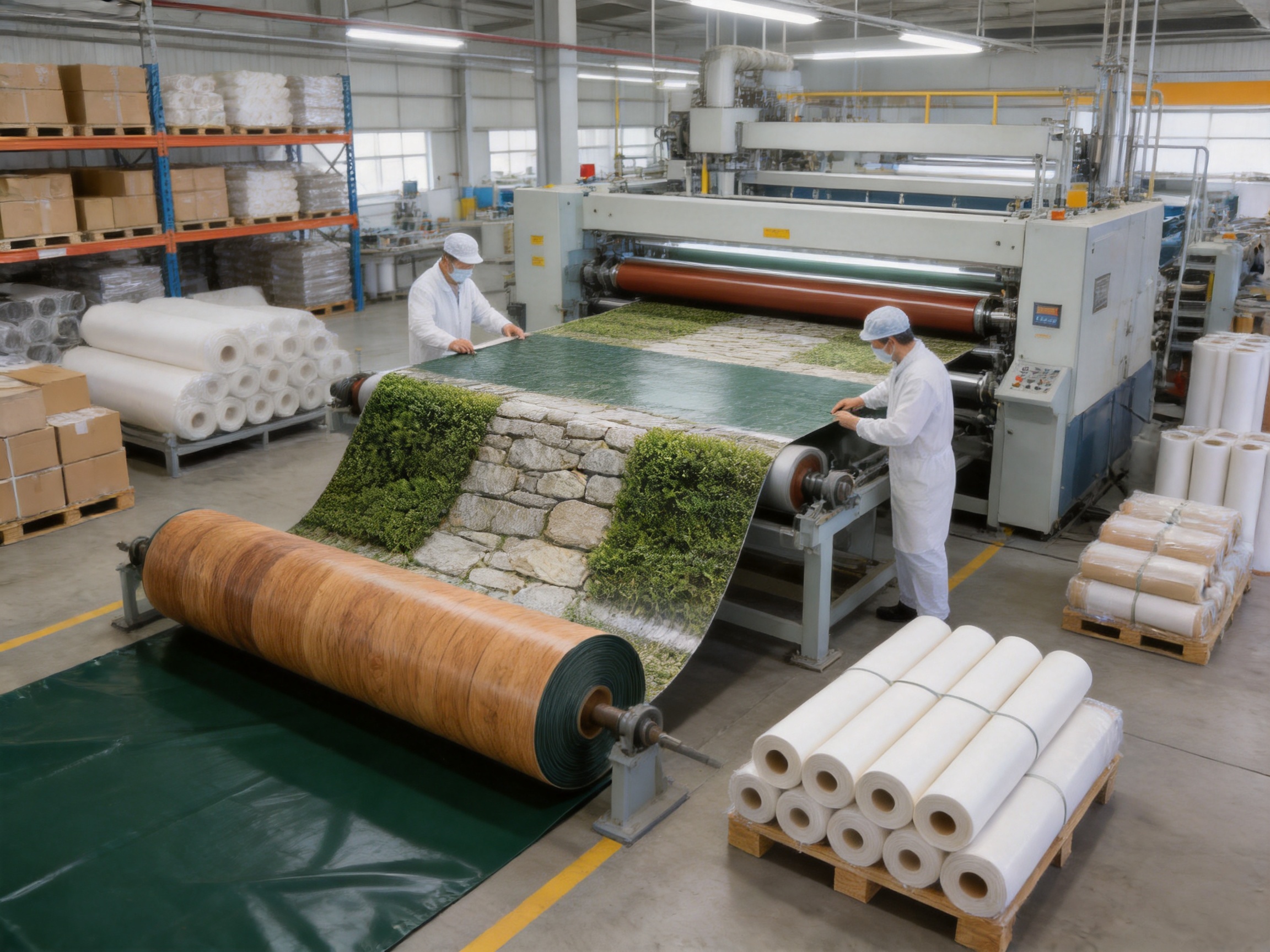
The company is equipped with advanced calendering equipment, multiple production lines, and professional bonding facilities. Calendering is an important process for forming and refining polymer films. It can help control thickness, surface smoothness, flexibility, and the appearance of the finished sheet. Consistent calendering is particularly important for a printed product because surface variation can affect print reception and visual uniformity.
Multiple production lines provide manufacturing flexibility. They can support different widths, weights, coating structures, colors, and product specifications. This is valuable for buyers who need both standard inventory and customized orders. Production flexibility also helps serve different market segments, from garden retail rolls to larger industrial applications.
Professional bonding facilities support the joining and lamination of material layers. Strong interlayer adhesion helps prevent peeling, separation, and premature failure. The stated adhesion value of 60 N/5 cm provides a technical indication of the bond strength between the coating and textile structure.
The company reports an annual output of approximately 45 million square meters. This production scale can support larger orders and ongoing supply programs. It also indicates experience in organizing raw materials, production scheduling, quality management, packaging, and export logistics.
The manufacturer’s product features include cold resistance, flame retardancy, UV resistance, antistatic performance, mildew-proof properties, and antibacterial characteristics across relevant product categories. Specific performance must be confirmed for the selected decorative tarpaulin specification, because not every characteristic necessarily applies to every product. Nevertheless, the broader technical portfolio demonstrates an emphasis on functional coated materials rather than purely decorative textiles.
Technological innovation is identified as a company priority. For garden fence screening, innovation may involve improved coating formulations, better print compatibility, stronger weathering performance, optimized roll formats, improved packaging, and more efficient production. These developments can help the product remain competitive as customers demand better appearance and longer service life.
Professional buyers should evaluate more than appearance when sourcing decorative fence tarpaulin. The base fabric, coating adhesion, tensile strength, tearing strength, waterproof behavior, print stability, roll dimensions, packaging, and consistency between batches all influence product performance.
Technical data should be reviewed together with samples. A sample can help buyers evaluate color, opacity, flexibility, surface feel, edge behavior, and print definition. For large projects, a pre-production sample or approved reference sample can reduce the risk of variation.
Roll length and width should be checked against the customer’s installation method. A product designed for weaving through a grid fence may not be suitable for every solid-panel or post-and-rail system without additional fastening accessories.
Packaging should protect the printed surface from abrasion, moisture, and compression damage. Individual rolls should be securely wrapped, clearly labeled, and packed in cartons or other formats appropriate for transportation and retail display.
Buyers should also request guidance regarding storage. Rolls should generally be kept dry, protected from direct sunlight, and stored in a way that avoids crushing or permanent deformation. Proper storage before installation helps preserve the appearance and handling characteristics of the material.
Successful installation begins with a sound fence. Posts, rails, and mesh panels should be checked for corrosion, looseness, sharp edges, and structural weakness before the screen is attached. Any sharp protrusions should be removed or covered to reduce the risk of puncturing the tarpaulin.
The required length should be measured carefully, including any returns around posts and overlaps between adjacent sections. A small allowance can be made for finishing, but unnecessary excess should be avoided because it may create folds and additional wind load.
The screen should be aligned along the fence before final attachment. Fastening can proceed from one end to the other while maintaining even tension. The material should be secure but not stretched aggressively. Excessive tension may transfer unnecessary force to the fence or cause stress around attachment points.
On long fence runs, additional intermediate fasteners are recommended. Corners, ends, gates, and areas exposed to stronger wind may require closer spacing or reinforcement. If the screen is installed in a region with severe storms, professional assessment of the fence and attachment system is advisable.
After installation, the screen should be inspected periodically. Loose fasteners, accumulated debris, damaged edges, and areas of unusual movement should be corrected promptly. Good maintenance can extend the practical service life and preserve the visual quality of the installation.
Durability is an important environmental consideration because a longer-lasting screen may reduce the frequency of replacement. A product that resists rain, mildew, UV exposure, and tearing can remain useful for a longer period when correctly installed and maintained.
Efficient roll formats can also reduce packaging and transport volume compared with rigid panels. The material can be supplied in lengths suited to a particular project, helping reduce unnecessary offcuts. When cutting is required, leftover material may be retained for repairs, small garden sections, temporary covers, or replacement panels.
At the end of its service life, disposal should follow local requirements for coated PVC and composite textile materials. Buyers and distributors should consider regional recycling and waste-handling options. The exact disposal route may depend on the composition of the coating, textile base, inks, and any attached hardware.
Regular cleaning supports both appearance and service life. Dirt and organic deposits should not be allowed to remain on the surface for extended periods, especially in shaded and humid areas. Gentle cleaning is preferable to aggressive chemical treatment.
The strongest competitive advantage of this decorative waterproof tarpaulin is its combination of functions. Many alternatives offer privacy but lack decorative flexibility. Others provide a pleasing appearance but absorb moisture or deteriorate quickly outdoors. Some are durable but difficult to install or transport. This product is positioned between these categories, combining visual coverage, weather resistance, flexible handling, and print customization.
The 450 g/m² construction gives the material a substantial feel while preserving rollability. The 300D × 500D structure and 18 × 12 specification support a dense, stable base. Tensile strength of 200/180 N per 5 centimeters, tearing strength of 100/80 N, and adhesion of 60 N per 5 centimeters provide measurable performance information for technical comparison.
The product also benefits from retail adaptability. Standard narrow rolls are suitable for DIY consumers, while custom widths, lengths, carton boxes, and individual packaging support different sales channels. This flexibility can help distributors create product lines for household, professional, and commercial customers.
Finally, the supplier’s production experience adds value. A company with multiple production lines, calendering equipment, bonding facilities, export experience, and high annual capacity is better positioned to support repeat orders than a small workshop focused only on one-off production. Buyers can discuss standard specifications, printed patterns, packaging requirements, and custom development with a manufacturer experienced in coated textile products.
It is mainly used as a privacy and decorative covering for garden fences, metal railings, mesh panels, balconies, patios, temporary barriers, and selected commercial outdoor spaces. It blocks direct views while improving the appearance of the fence.
The dense structure is designed to provide highly opaque visual coverage. The final level of privacy depends on correct installation, overlaps, fence design, viewing angle, and whether gaps remain around the edges.
Yes. The printable surface can support decorative patterns such as hedge, stone, wood-grain, and other landscape designs. Custom graphics and packaging should be discussed with the manufacturer before production.
The waterproof coating and mildew-resistant design make it suitable for many rainy and humid outdoor environments, including regions of Europe. Installation, drainage, cleaning, and local weather exposure will affect long-term performance.
Yes. The flexible material can be cut to suit different fence lengths, heights, corners, gates, and partial sections. Clean cutting and suitable edge fastening are recommended for a professional result.
Possible methods include cable ties, clips, lacing cord, rope, eyelets, and other compatible fasteners. The correct method depends on the fence type, wind exposure, screen dimensions, and installation requirements.
Anti-UV treatment helps slow fading and weathering. However, all outdoor printed materials may gradually change color under prolonged sunlight, particularly in areas with intense UV exposure. Careful installation and routine maintenance can help preserve appearance.
The stated specification is 300D × 500D, 18 × 12, and approximately 450 g/m². Listed mechanical values include tensile strength of 200/180 N per 5 centimeters, tearing strength of 100/80 N, and adhesion of 60 N per 5 centimeters.
Yes. The product can support custom carton box cutting, individual retail packaging, and standard consumer roll formats. Packaging details should be agreed according to the retailer’s sales channel and market requirements.
The tarpaulin is designed to resist normal handling and mild pulling, but any solid screen increases wind load. In exposed areas, the fence structure, post strength, fastening spacing, and local weather conditions should be assessed by a qualified installer.
The product is manufactured by Haining Taiwei New Material Co., Ltd., a Haining, Zhejiang-based producer of PVC films, digital printing fabrics, tarpaulin films, mesh, frontlit and backlit materials, and related coated products.
Decorative waterproof tarpaulin for garden fence screening offers a practical way to combine privacy, outdoor protection, and visual improvement. Its dense coated construction is designed to block direct views, resist rainwater penetration, reduce moisture-related problems, and support reliable use in changing outdoor conditions.
The 300D × 500D construction, 18 × 12 weave, approximate 450 g/m² weight, measurable tensile and tearing strength, and 60 N/5 cm adhesion provide a solid technical foundation. Anti-UV treatment helps protect the printed surface, while flexible roll formats simplify installation and distribution.
For homeowners, the product can transform an exposed garden into a more private and attractive space. For landscapers and contractors, it provides a flexible material that can be cut and adapted to different fence configurations. For retailers and wholesalers, standard consumer rolls, custom packaging, and printable designs create opportunities for differentiated product lines.
Supported by Haining Taiwei New Material Co., Ltd.’s experience in PVC films, digital printing fabrics, tarpaulin films, mesh, calendering, bonding, and export manufacturing, the product is positioned as a versatile outdoor screening solution. Its combination of privacy, decorative potential, waterproofing, UV resistance, flexible handling, and production scalability gives it clear advantages over many basic fence-covering alternatives.
1. Haining Taiwei New Material Co., Ltd. Product specification information for decorative waterproof tarpaulin and related coated materials.
2. Haining Taiwei New Material Co., Ltd. Company information regarding PVC film, digital printing fabric, tarpaulin film, mesh, frontlit, backlit, and bonding production capabilities.
3. Technical specification summary for 300D × 500D, 18 × 12, approximately 450 g/m² coated tarpaulin construction.
4. General principles of outdoor coated textile selection, including tensile strength, tearing strength, adhesion, UV resistance, waterproofing, and mildew resistance.
5. General installation and maintenance practices for flexible privacy screens used on garden fences and outdoor railings.
Decorative Waterproof Tarpaulin For Garden Fence Screening
 Thickened Privacy Waterproof Tarpaulin For Garden Barrier Fence
 All Weather Heavy Duty Mesh Tarpaulin for Barrier Fencing
 Heavy-Duty Reinforced Waterproof Tarpaulin
 Anti UV Long Lasting Blackback Outdoor flex Banner Fabric
 Anti Fouling Weatherproof Tarpaulin For Swimming Pool Cover
 Custom Digital Printing Fabric Manufacturers

 Previous